Great interactions rarely call attention to themselves. They make actions obvious, outcomes predictable, and products feel natural to use. These four principles explain how.

Every interaction with your product is a chance to build trust. As designers, we shape these moments from the first time someone uses what we've created. When users invest their time, money, and attention in our products, we take on the responsibility of delivering value in return.
Interaction design is the art and science of creating meaningful relationships between products and people. It's about crafting experiences that feel natural, intuitive, and rewarding.
In this article, I'll explore the fundamental principles of interaction design with real-world examples that demonstrate how thoughtful design creates products people actually understand and enjoy using.
Understanding Interaction
At its core, interaction is simply a continuous conversation between two or more parties. We interact with our partners, our pets, our colleagues, and yes, the digital devices that have become extensions of our daily lives.
What Is Interaction Design?
When we use a product, we naturally expect it to behave in ways that make sense to us. We draw on our habits, seek comfort, and look for usefulness. Products that fail to meet these expectations often get abandoned, no matter how powerful their features might be.
Interaction design is the practice of creating meaningful conversations between products and the people who use them.
It's about designing systems that meet user needs while responding in ways people naturally expect. The best interaction design feels almost invisible, it just works the way you think it should.
The Four Fundamental Principles
1. Affordance
Our world is filled with objects, both natural and artificial. Each one suggests possibilities through its form and function. A pen affords writing. A smartphone affords communication, entertainment, and productivity. These inherent qualities that enable interaction are called affordances.
Affordances define the relationship between an object's properties and a person's capabilities.
Consider a door. It affords opening and closing. A doorknob affords gripping and turning. A lock affords security. Each element offers specific possibilities for interaction based on its physical design.
As designers, we must carefully consider affordances based on our target users' abilities. When there's a perfect balance between what a product offers and what users can do with it, the experience feels effortless and satisfying.

Affordance example
2. Signifiers
While affordances define what's possible, signifiers communicate what actions to take and where to take them.
Signifiers are the visual, auditory, or tactile clues that guide users toward correct actions.
People constantly look for hints about how to use products. A highlighted button suggests "click here." An underlined word implies it's a link. A subtle animation indicates something is loading. These signals help users understand their options and navigate with confidence.
Effective signifiers make actions and affordances visible. Sometimes, we deliberately hide certain signifiers to reduce complexity or maintain visual clarity. The key is understanding context and applying signifiers strategically to guide users without overwhelming them.
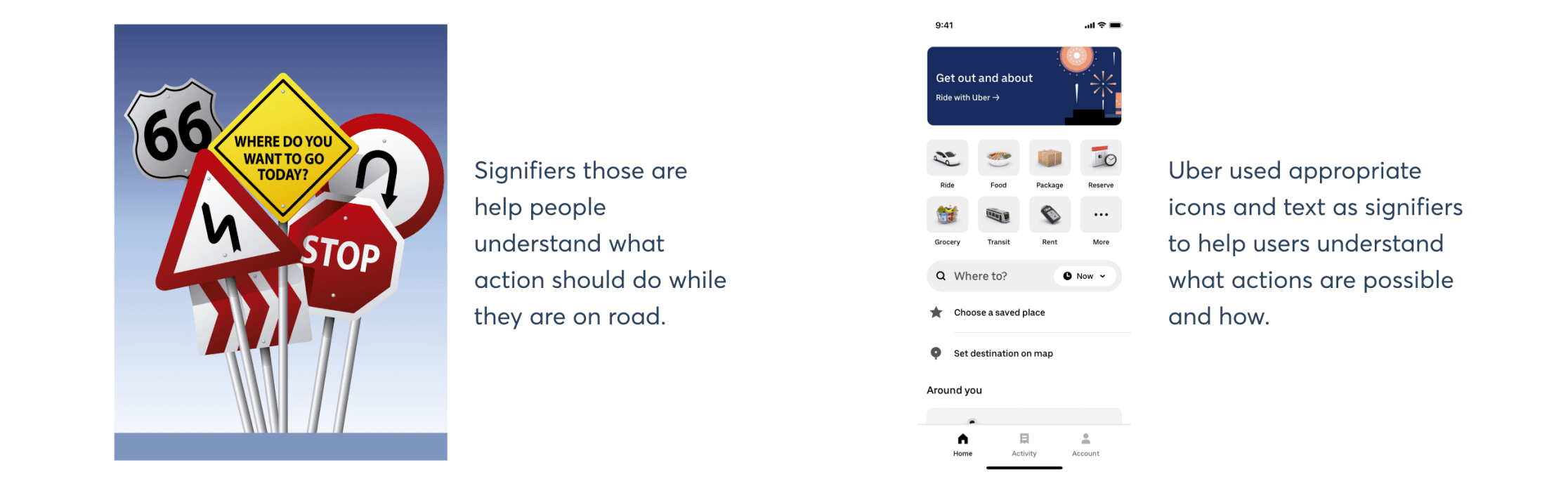
Fig: Signifiers
3. Mapping
Mapping describes the relationship between controls, their movements, and the results they produce in the real world.
Consider the difference between English books and Japanese manga. English books are read left to right, with pages flipped from right to left to advance. Manga follows the opposite pattern, reading right to left, with pages flipped left to right.
Good mapping leverages natural behaviors and cultural conventions.
When designing an eBook reader, respecting these natural mappings is crucial. English readers expect to swipe or tap on the right to turn pages forward. Manga readers expect the opposite. By aligning digital interactions with established physical patterns, we create experiences that feel intuitive from the first moment.
Effective signifiers make actions and affordances visible. Sometimes, we deliberately hide certain signifiers to reduce complexity or maintain visual clarity. The key is understanding context and applying signifiers strategically to guide users without overwhelming them.

Fig: English & Manga book
4. Feedback
Feedback communicates what action has occurred and what result has been achieved. It closes the loop of interaction.
Every action deserves a reaction.
When you flip a light switch, you expect the light to turn on or off immediately. When you tap a button on your phone, you anticipate a visual response : a color change, a new screen, a confirmation message. These signals confirm that your action was registered and show you the outcome.
Effective feedback is timely, clear, and aligned with user expectations. It reassures users that the system is working and helps them understand whether their goals were achieved. Without feedback, users are left wondering if their actions had any effect at all.

Electric Switch & Mobile

Bringing It All Together
Written by